Why Global Enterprises Choose Offshore AI Development in India
Building custom autonomous systems in-house strains corporate budgets and drains engineering resources. The global shortage of machine learning engineers makes scaling AI initiatives domestically an expensive, slow-moving bottleneck. When you struggle to hire specialized talent locally, your AI roadmap stalls while competitors scale ahead. Opting for offshore AI development in India allows enterprises to build sophisticated systems at a fraction of domestic costs. Understanding the full scope of AI agent development services is key to planning your budget effectively and constructing high-performing autonomous agents without overspending.
By partnering with an offshore software agency in India, companies can bypass local recruitment struggles and deploy fully integrated AI solutions. This guide provides a detailed, data-driven analysis of how global brands utilize Indian tech talent to build complex autonomous systems, balance budgets, and manage data compliance.
Global enterprises are shifting their focus from traditional software development outsourcing to advanced artificial intelligence engineering. The primary driver is the ability to execute complex machine learning projects without the prohibitive costs of local development. By establishing partnerships for offshore AI development in India, enterprises access specialized skills that are scarce in Western markets.
As a leading digital partner, Kashtbhanjan Digital helps businesses bridge this gap. With over 15 years of industry experience, we assist organizations in navigating the complexities of remote engineering, ensuring that your transition to offshore development yields predictable, high-value outcomes.
Accessing India's Massive AI Engineering Talent Pool
The scale of the AI engineering talent pool in India is unmatched. Every year, India produces hundreds of thousands of engineering graduates with deep specializations in mathematics, data science, and computer science. This vast talent pipeline has fueled the growth of Indian AI startups and attracted global technology giants to set up dedicated research centers in the country.
When you hire remote AI developers in India, you are not just hiring programmers who write code. You are securing access to highly specialized machine learning engineers who understand neural network architectures, deep learning models, and complex data pipeline engineering. This concentration of expertise allows global companies to rapidly scale their development teams and shorten time-to-market for complex AI products.
Ahmedabad Tech Companies: The New Epicenter for Autonomous System Engineering
While cities like Bengaluru and Hyderabad have historically dominated India IT outsourcing, Ahmedabad has emerged as a premier tech hub. Ahmedabad tech companies are gaining international recognition for their highly specialized focus on autonomous system engineering, custom software development, and advanced machine learning integrations.
Ahmedabad offers a highly stable business environment, modern infrastructure, and a rapidly growing community of technical professionals. By collaborating with agencies in this region, enterprises benefit from lower operational overhead compared to tier-one Indian cities, translating directly into competitive project pricing without any compromise on technical quality or delivery standards. Our AI agent development team in India is headquartered in Ahmedabad and operates with this exact model.
Nearshore vs Offshore AI: Choosing the Best Delivery Model
When planning to outsource AI agent development, enterprise decision-makers often weigh the benefits of nearshore versus offshore AI. Both models offer distinct advantages depending on your internal resources, budget flexibility, and project complexity.
Nearshore development (such as outsourcing to Latin America for US firms, or Eastern Europe for UK firms) offers closer geographical proximity and overlapping working hours. However, the talent pools in these regions are significantly smaller, and the hourly rates remain substantially higher than those found in the Indian market. The table below outlines the key differences:
| Comparison Factor | Nearshore AI Development | Offshore AI Development (India) |
|---|---|---|
| Average Hourly Rate | $70 – $130 USD | $30 – $75 USD |
| Talent Pool Size | Moderate (Regional limitations) | Massive (Hundreds of thousands of engineers) |
| Time-Zone Overlap | High (4 to 6 hours overlap) | Low to Moderate (Managed via overlapping shifts) |
| Technical Specialization | General software & basic AI integration | Deep ML research, custom LLMs, & multi-agent systems |
| Scalability Speed | Slow to Moderate | Rapid (Large teams deployable quickly) |
Nearshoring is highly effective for projects requiring real-time, synchronous collaboration throughout the standard workday. Conversely, offshore AI development in India offers unparalleled cost efficiency and access to specialized technical skills. Most established Indian development firms operate on overlapping shifts to ensure daily synchronous communication — creating a continuous development cycle where tasks assigned at the end of your workday are delivered before you log in the next morning.
The Cost of Hiring AI Developers: US vs. India
The cost of hiring AI developers domestically in the United States has reached historic highs. High demand coupled with a limited supply of qualified machine learning engineers has pushed average annual salaries past $180,000 USD, excluding benefits, office space, and recruitment fees.
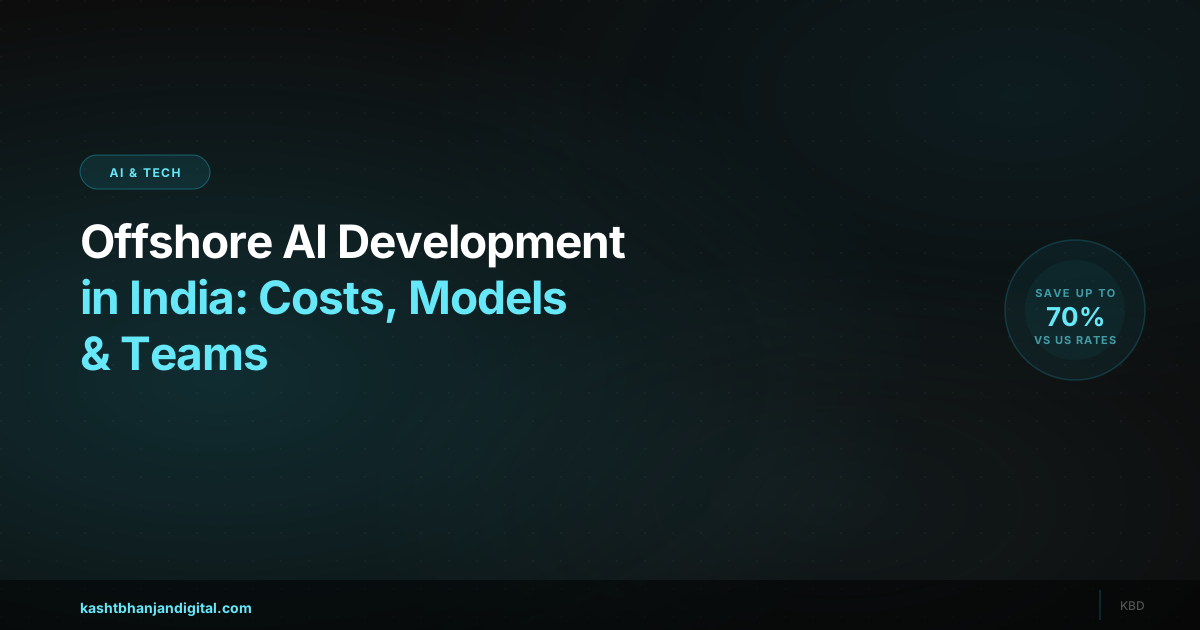
By shifting your development strategy to India, you can optimize your custom AI development cost. The cost differential is not a reflection of lower quality, but rather a result of the lower cost of living in Indian tech hubs. This economic reality allows global enterprises to secure elite technical talent at a fraction of domestic costs.
| Role | United States (Hourly) | India (Hourly) | Savings |
|---|---|---|---|
| Senior ML Engineer | $150 – $250 USD | $45 – $75 USD | ~70% |
| Data Engineer | $120 – $180 USD | $35 – $55 USD | ~70% |
| AI Architect | $200 – $300 USD | $60 – $90 USD | ~70% |
| QA Automation Specialist | $90 – $140 USD | $25 – $40 USD | ~72% |
Custom AI Development Cost Breakdown
To understand how these hourly rates translate into complete project budgets, it is helpful to break down the core phases of building a custom AI agent:
- Data Preparation & Pipeline Engineering: Cleaning, structuring, and labeling proprietary data to train or fine-tune models. Utilizing offshore teams in India for this phase significantly reduces the cost of labor-intensive data engineering tasks.
- Model Selection & Fine-Tuning: Selecting the appropriate open-source model or training a customized architecture. This requires highly skilled machine learning engineers who understand hyperparameter tuning and optimization.
- Integration & API Development: Connecting the AI model to your existing enterprise software, databases, and customer-facing channels.
- Testing & Quality Assurance: Rigorously testing the agent's outputs to eliminate hallucinations, ensure security, and optimize response latency.
By leveraging Indian engineering teams, an enterprise can complete a custom AI agent project for $30,000 to $70,000 USD, whereas the same scope of work would easily exceed $150,000 to $200,000 USD when executed entirely within the United States.
Advanced Architecture Gaps: Multi-Agent Frameworks and Local LLMs
Many generalist outsourcing firms treat AI development as a simple wrapper around basic public APIs. This approach fails to address the complex architectural needs of global enterprises. Advanced AI engineering requires sophisticated systems that can operate independently, handle complex workflows, and run cost-effectively at scale.
Multi-Agent Collaboration Frameworks (CrewAI) for Back-Office Automation
Modern enterprise automation has evolved beyond simple, single-prompt chatbots. Today, high-value operations rely on multi-agent systems where specialized AI agents collaborate to solve complex business problems — a key difference between AI agents and traditional chatbots. Using advanced frameworks like CrewAI, developers can design ecosystems where different agents take on distinct roles.
For example, in a back-office automation scenario, a Researcher Agent can extract data from unstructured financial documents, a Writer Agent can format that data into a standardized compliance report, and a QA Agent can cross-reference the output against internal business rules to verify accuracy. This multi-agent collaboration reduces human intervention to a simple final approval, dramatically accelerating operational speed while maintaining high quality standards.
Deploying On-Premise LLMs (Llama 3, Mistral) to Eliminate API Cost Scaling
Relying solely on external proprietary APIs (like OpenAI or Anthropic) introduces significant financial risk as your user base scales. High-volume enterprise operations can run up thousands of dollars in daily API call costs. Furthermore, sending sensitive proprietary data to external servers raises security and privacy concerns.
To mitigate these challenges, skilled AI developers in India focus on deploying open-source, on-premise LLMs such as Llama 3 or Mistral on private cloud servers. By fine-tuning these models on your specific business data and implementing Retrieval-Augmented Generation (RAG), you achieve performance levels comparable to proprietary models while eliminating recurring API transactional costs entirely. This strategy ensures long-term cost predictability and complete control over your data infrastructure.
Navigating Compliance: The Indian DPDP Act for Generative AI Pipelines
When offshoring AI projects, data security and regulatory compliance must be top priorities. India has modernized its regulatory framework with the Digital Personal Data Protection (DPDP) Act of 2023. This legislation directly impacts how personal data is collected, processed, and stored within AI data pipelines.
The DPDP Act imposes strict requirements on data fiduciaries and processors. When building AI systems that utilize customer data for training, fine-tuning, or real-time processing through RAG, the offshore development agency must implement rigorous compliance protocols:
- Strict Consent Architectures: Ensuring all personal data processed by the AI system is backed by clear, revocable consent.
- Data Minimization: Designing pipelines that only ingest the specific data points required to perform the AI agent's designated task.
- Anonymization & Pseudonymization: Automatically stripping personally identifiable information (PII) before data is used to train or fine-tune models.
- Local Storage Compliance: Adhering to cross-border transfer rules as outlined by the Indian government and international standards like GDPR.
Partnering with an offshore software agency in India that understands and actively implements DPDP Act compliance ensures your enterprise remains fully aligned with global data protection standards, preventing costly legal issues and protecting your brand's reputation.
Selecting the Right Offshore Delivery Model
Success in offshore AI development depends on selecting an engagement model that aligns with your internal technical capabilities, project timeline, and budget structure. There is no one-size-fits-all approach; different projects require different levels of management and integration.
The three most common offshore delivery models include:
- Staff Augmentation: Adding individual remote developers to your existing in-house team to fill specific skill gaps. Best when you have internal engineering leadership.
- Dedicated Development Team: Hiring a complete, self-managed team of AI engineers, data scientists, and project managers dedicated entirely to your business. Best for building AI products from scratch.
- Project-Based Outsourcing: Partnering with an agency to deliver a specific, fully defined AI product under a fixed-price or time-and-materials contract. Best for well-scoped, one-time projects.
Staff Augmentation vs. Dedicated Remote AI Developers
If your company already has an established internal engineering team led by an experienced CTO or AI Architect, staff augmentation is highly effective. This model allows you to quickly hire dedicated AI team members to accelerate your timeline, paying only for the specific hours worked without the overhead of full-time domestic employment.
However, if you are building an AI product from scratch or lack internal machine learning expertise, hiring a dedicated remote AI development team is the superior choice. This team comes fully equipped with the necessary management structures, QA processes, and technical leadership to take your project from initial concept to deployment.
Offshore AI Development Services Available in Your Country
Kashtbhanjan Digital's offshore AI development team in India serves enterprise and mid-market clients across 7 countries. Select your location to see country-specific pricing, compliance details, and engagement models.
United Kingdom
Offshore AI agents for UK businesses. UK GDPR compliant, IST/GMT overlap shifts.
View UK services →Germany
Offshore AI development for German companies. GDPR and EU AI Act aligned.
View Germany services →Australia
Indian offshore AI teams for Australian enterprises. Privacy Act 1988 compliant.
View Australia services →Canada
Offshore AI agent development for Canadian businesses. PIPEDA compliant.
View Canada services →New York
Offshore AI development for New York enterprises and scale-ups.
View New York services →New Jersey
Custom AI agents built offshore in India for New Jersey SMBs and enterprises.
View New Jersey services →Frequently Asked Questions About Offshore AI Development
Will AI replace offshore developers?
No, AI will not replace offshore developers; instead, it shifts their focus. Developers who leverage AI tools and build custom AI agents are seeing massive productivity gains, transforming the offshore model from simple code execution to high-value system architecture and custom software integration.
Which country is no. 1 in AI?
While the United States leads in foundational AI research and LLM creation, India is rapidly becoming the premier global destination for offshore AI development, implementation, and agentic system engineering due to its vast engineering talent pool.
What is the custom AI development cost when offshoring to India?
Offshoring custom AI development to India typically reduces development costs by 60% to 70% compared to domestic US rates. Hourly rates for highly skilled machine learning engineers in Indian tech hubs range from $30 to $75, compared to $150+ in North America.
How does the Indian DPDP Act impact offshore AI development?
The Digital Personal Data Protection (DPDP) Act of India regulates how data pipelines are managed. Offshore development teams must ensure compliance when handling personal data to train or fine-tune generative AI models, offering peace of mind to global enterprises concerned with global compliance standards like GDPR.
Maximize Your ROI: Request an Offshore Team Pricing Guide
Choosing offshore AI development in India is a strategic decision that allows your business to innovate rapidly, optimize operational budgets, and access world-class engineering talent. By partnering with an experienced agency, you can navigate the technical, operational, and regulatory challenges of building custom autonomous systems with confidence.
Ready to scale your technical capabilities? Contact Kashtbhanjan Digital to discuss your project requirements and receive a customized estimate tailored to your goals. Explore our AI agent development services in India or view offerings for the UK, Germany, Australia, Canada, New York, and New Jersey.