In the rapidly evolving landscape of artificial intelligence and digital integration, understanding the core technologies that enable intelligent systems to communicate is crucial. For business owners looking to enhance their operations with AI agents and developers building these solutions, the distinction between an Application Programming Interface (API) and the Model Context Protocol (MCP) can be complex. Both are vital for how software components interact, but they serve different purposes, especially when it comes to sophisticated AI agent integration and Large Language Models (LLMs).
Kashtbhanjan Digital, an AI agent development and SEO agency based in Ahmedabad, India, and serving global markets since 2004, helps businesses navigate these technical distinctions to build robust and effective digital strategies. This guide will clarify the fundamental differences between MCP and API, explain their respective strengths, and illustrate how they are used, particularly in the context of digital marketing and web development.
Introduction to MCP and API: Setting the Stage
To grasp the nuances of MCP vs API, we first need a clear understanding of each concept. While APIs have been a cornerstone of software development for decades, MCP represents a newer paradigm, specifically designed to address the unique challenges of AI agent tool use and dynamic interaction.
What is an API? The Traditional Interface
Application Programming Interface (API): An API is a set of defined rules that allows different software applications to communicate with each other. Think of it as a menu in a restaurant: it lists what you can order (functions) and how to order it (parameters), but you don't need to know how the kitchen prepares the food. APIs enable secure and standardized data exchange and function execution between systems.
Most APIs are RESTful APIs, meaning they adhere to the principles of Representational State Transfer, using standard HTTP methods (GET, POST, PUT, DELETE) to interact with resources. The OpenAPI Specification is a widely used standard for describing RESTful APIs, making them easier for developers to understand and integrate.
A common example is how a weather app uses an API to fetch real-time weather data from a meteorological service, or how an e-commerce site uses a payment gateway API to process transactions. Even popular AI models like ChatGPT offer an API, allowing developers to integrate ChatGPT's powerful natural language processing capabilities into their own applications programmatically.
What is Model Context Protocol (MCP)? A New Paradigm for AI
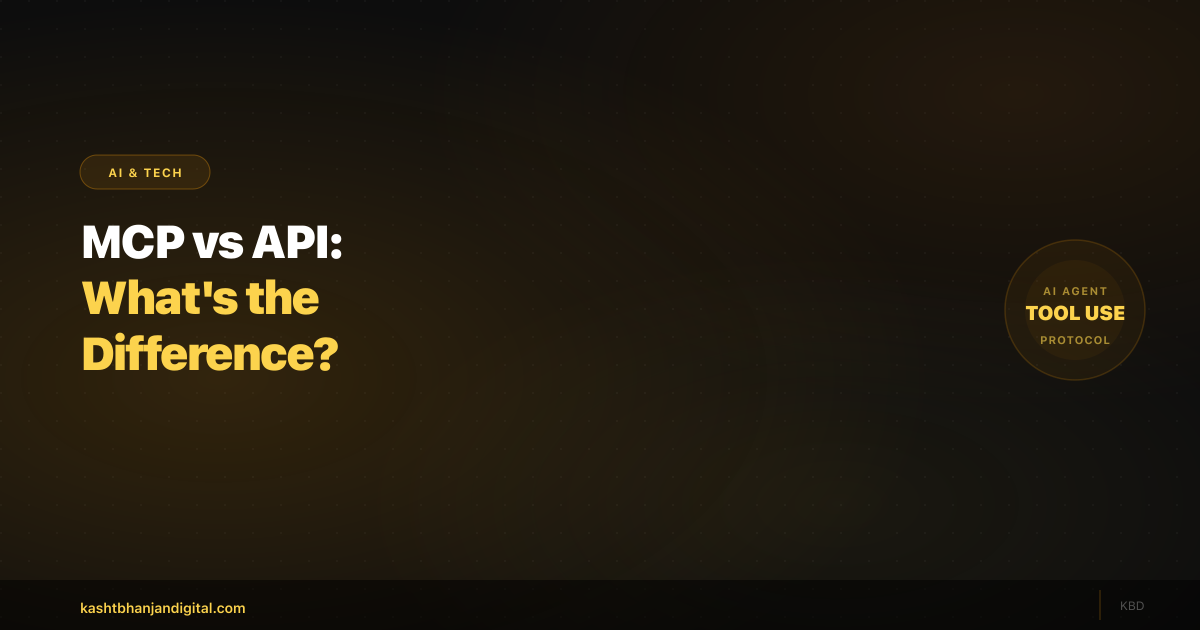
Model Context Protocol (MCP): MCP is a protocol specifically engineered to enable AI systems, particularly LLMs and AI agents, to understand, discover, and dynamically interact with a vast array of tools and APIs based on real-time context and user intent. It's not an API itself, but rather a standardized layer that sits above existing APIs, making them "AI-native."
Where an API provides specific functions to call, MCP provides a structured way for an AI agent to *reason* about which functions are available, what they do, and how to use them to achieve a goal. This concept is often referred to as "Tool Use" for AI agents. It reduces the manual integration effort for developers by allowing AI to interpret and interact with diverse services more autonomously. Is MCP just a fancy API? No, it's a critical enabler for intelligent agents to go beyond static calls and truly understand their environment.
MCP vs API: Key Differences at a Glance
While both APIs and MCP facilitate communication between software components, their fundamental design and purpose diverge significantly, especially concerning AI agent integration. Here's a quick comparison of their core aspects:
Functionality and Purpose: Execution vs. Discovery
The core distinction lies in their primary function. APIs are fundamentally about *execution*. They allow you to send a request and receive a response, performing a specific task or retrieving specific data. MCP, on the other hand, is about *discovery* and *intelligent utilization*. It provides the semantic layer an AI agent needs to understand the *capabilities* of various APIs and tools, and then decide which one to use to fulfill a complex request.
Interaction Model: Static Endpoints vs. Dynamic Intent
With an API, interaction is typically based on static endpoints. A developer knows exactly which URL to call and what parameters to provide. The interaction is predefined. MCP introduces a dynamic interaction model. An AI agent, powered by an LLM, can receive a high-level request ("Find the best flight to London next month") and then dynamically identify, understand, and interact with various flight booking APIs to fulfill that request, without having been explicitly programmed for each specific API beforehand.
Integration with AI Agents and LLMs
Integrating APIs directly with AI agents and LLMs can be labor-intensive. Each API requires custom code to translate the AI's intent into the API's specific call structure. MCP addresses this by providing a standardized layer for context provisioning and tool use. It allows LLMs to interpret API documentation and parameters more effectively, enabling a more autonomous and efficient AI agent integration process. This means AI agents can adapt to new tools more easily, without extensive re-programming.
Developer Effort and Implementation
For developers, implementing solutions with traditional APIs often means writing specific code for each integration. While powerful, this can become unwieldy with many services. MCP aims to reduce this developer effort for AI-driven systems. By standardizing the way AI agents discover and use tools, MCP allows developers to focus on defining the AI's goals rather than the intricate details of each API call. It streamlines website development by enabling quicker adoption of diverse services.
Security and Authentication Approaches
Both MCP and APIs incorporate security measures like authentication and authorization. APIs typically rely on standard protocols such as API keys, OAuth, or JWT tokens to secure direct access to their endpoints. MCPs, designed for orchestrating complex data workflows across diverse systems, often integrate more advanced security features, including robust data governance, compliance capabilities, and multi-factor authentication, tailored for handling sensitive data flowing between multiple services.
When to Use MCP vs. When to Use API
Understanding when to deploy an API, an MCP, or a combination of both is key to building efficient and scalable AI solutions. MCP vs API isn't a matter of choosing one over the other; it's about understanding their complementary roles.
Scenarios Favoring APIs
You should favor traditional APIs for:
- Direct, Predefined Integrations: When you need a specific application to perform a specific function with another application (e.g., a CRM pushing data to an email marketing platform).
- High-Volume, Repetitive Tasks: For tasks that are always the same and require consistent, fast execution without much dynamic interpretation.
- Exposing Specific Functionality: If you want to allow external developers to access a particular part of your software.
- Point-to-Point Communication: For straightforward data exchange between two systems.
Scenarios Favoring MCP
Consider MCP when:
- AI Agent Development: You are building AI agents or LLM applications that need to dynamically discover and use various tools/APIs based on user intent, rather than executing predefined, static workflows.
- Complex Workflow Automation: For scenarios requiring the AI to orchestrate multiple services or make decisions about tool usage in real-time.
- Reducing AI Integration Complexity: When you want to simplify how your AI system interacts with a growing number of diverse external services.
- Multi-Protocol Communication: MCPs are designed to support a wide array of communication protocols (HTTP, FTP, SFTP, AMQP), making them suitable for integrating a broader spectrum of legacy and modern systems where REST APIs, being HTTP-only, might fall short.
- Robust Data Governance: In environments requiring advanced security, compliance, and data transformation capabilities across disparate data sources.
The Synergy: How MCP Builds on APIs
No, MCP will not replace APIs. Instead, MCP is designed to complement APIs, acting as an intelligent layer that makes APIs more accessible and usable for AI systems. APIs still perform the actual data transfer and function execution. MCP provides the "brain" that guides the AI agent to choose and correctly operate the right API at the right time. They can be used together effectively. An API can expose specific functionalities, which an MCP then orchestrates and integrates with other data sources, creating a powerful synergy for complex data workflows and system interoperability. This combination allows for more sophisticated AI-driven solutions, leading to advancements in workflow automation and personalized user experiences.
MCP vs API in Digital Marketing and Web Development
The implications of MCP and API extend deeply into digital marketing strategies and web development, offering new avenues for efficiency and innovation. Kashtbhanjan Digital understands the future of online marketing hinges on these advanced protocols.
Streamlining Website Development with AI Integrations
For website development, APIs have long been indispensable, powering everything from content management systems to e-commerce platforms. With MCP, AI agents can take on more complex development tasks, such as dynamically generating website components, integrating various third-party services (like analytics, CRM, or payment gateways) based on a high-level brief, or even optimizing site performance by intelligently interacting with different tools. This significantly streamlines website development, making the process faster and more adaptive.
Enhancing SEO and Content Marketing with Dynamic Tools
In SEO services and content marketing, APIs enable tools for keyword research, competitor analysis, and analytics. MCP takes this a step further. An AI agent, guided by MCP, could dynamically conduct comprehensive SEO audits, generate highly personalized content tailored to specific audience segments by pulling data from multiple sources (e.g., trend analysis APIs, sentiment analysis APIs), or automate complex backlink strategies by identifying opportunities and interacting with various outreach platforms. This same dynamic, AI-native approach is exactly what powers AEO (Answer Engine Optimization), getting your business cited directly inside ChatGPT, Perplexity, and Google AI Overviews rather than just ranked in a list of blue links.
Future of Online Marketing with Advanced Protocols
The blend of MCP and API empowers digital marketing agencies to build more intelligent, responsive, and adaptive campaigns. From automated customer service agents that can access and synthesize information from multiple internal systems to highly targeted advertising campaigns that adjust in real-time based on dynamic market data, these protocols are foundational. Kashtbhanjan Digital, with its expertise in AI agent development and digital marketing, is at the forefront of leveraging these technologies to deliver complete digital marketing solutions that drive business growth for clients globally.
Frequently Asked Questions About MCP and API
Is MCP the same as API?
No, MCP and API are not the same. APIs are general-purpose interfaces for data exchange and execution, while MCP specifically enables AI agents to discover, understand, and utilize APIs more effectively, building a layer on top of existing APIs.
Will MCP replace APIs?
No, MCP is designed to complement, not replace, APIs. APIs continue to perform the actual work of data transfer and function execution. MCP adds a standardized layer that makes these APIs more accessible and usable for AI systems.
Is MCP just a fancy API?
While MCP works with APIs, it's more than just a 'fancy API.' It's a protocol specifically designed for LLMs to interpret and interact with APIs in a more dynamic, intent-driven manner, reducing the manual integration effort for developers.
Is ChatGPT an API?
ChatGPT itself is an AI model, but OpenAI provides an API (Application Programming Interface) that allows developers to integrate ChatGPT's capabilities into their own applications and services, enabling programmatic access to its features.
When should I use MCP over a traditional API?
You should consider using MCP when integrating AI agents or LLMs that need to dynamically discover and use various tools/APIs based on user intent, rather than executing predefined, static workflows. It simplifies the AI's ability to interact with diverse services.
How do MCP and APIs impact digital marketing strategies?
Both MCP and APIs can significantly impact digital marketing. APIs power many tools (e.g., analytics, social media integrations). MCP, by simplifying AI interaction with these tools, can enable more sophisticated AI-driven content generation, personalized marketing, and automated campaign management.
What are the key differences in architecture between MCP and APIs?
MCPs often feature a more centralized and opinionated architecture designed for specific data integration challenges, often involving multiple protocols and complex transformations. Traditional APIs, conversely, typically offer a more granular, point-to-point architecture focused on single service interactions, adhering to protocols like HTTP/REST.
How do MCPs and APIs handle security differently?
While both leverage security measures like authentication and authorization, MCPs often incorporate advanced security features tailored for handling sensitive data across diverse systems, including robust data governance and compliance capabilities. APIs rely on standard security protocols, which may require additional custom implementation for complex multi-system security needs.
Can MCP and APIs be used together effectively?
Absolutely. MCPs and APIs are not mutually exclusive; they can complement each other. APIs can expose specific functionalities that an MCP then orchestrates and integrates with other data sources, creating a powerful synergy for complex data workflows and system interoperability.
What are some common use cases for MCP?
MCPs are particularly useful in scenarios requiring complex data integration from disparate sources, real-time data synchronization, multi-protocol communication, and robust data governance. They excel in environments where traditional APIs might become unwieldy due to the sheer volume and variety of integrations needed.
How does multi-protocol support differentiate MCP from REST APIs?
REST APIs are fundamentally built on HTTP, limiting them to web-based communication. MCPs, however, are designed to support a wide array of communication protocols beyond HTTP, such as FTP, SFTP, AMQP, and more, making them suitable for integrating a broader spectrum of legacy and modern systems.
Conclusion: Navigating the Future of AI Integration
The distinction between MCP vs API is critical for any business owner or developer keen on harnessing the full potential of AI agents. While APIs remain the backbone for countless software integrations, MCP emerges as the intelligent layer that empowers AI to use these APIs dynamically, understand context, and drive more sophisticated outcomes. They are not competing technologies but rather synergistic components of a modern AI ecosystem.
As an AI agent development and SEO agency serving clients since 2004, Kashtbhanjan Digital specializes in building complete digital marketing solutions that integrate these advanced protocols. We help businesses in Ahmedabad, India, and across global and DACH markets to develop custom AI agents that can truly understand and interact with the digital world, ensuring your strategies are not just current, but future-proof. Whether you need robust WordPress website development, advanced SEO services, or comprehensive digital marketing strategies, we are your partner in navigating the complexities of AI integration for business growth.
Partner with Kashtbhanjan Digital
Kashtbhanjan Digital builds custom AI agents and MCP-ready integrations for businesses that want their AI systems to actually understand and use their tools, not just call fixed endpoints. If you need help evaluating whether your next integration needs an API, MCP, or both, or want a complete digital marketing and AI strategy, our team can help.
Select your location below for country-specific AI agent development services.
India
Custom AI agent development and MCP-ready integrations for Indian businesses and startups.
View India services →United Kingdom
AI agents and MCP-based integrations for UK businesses, UK GDPR compliant.
View United Kingdom services →Germany
AI agent development for German companies, GDPR and EU AI Act aligned.
View Germany services →Australia
Custom AI agents for Australian enterprises, Privacy Act 1988 compliant.
View Australia services →Canada
AI agent development for Canadian businesses, PIPEDA compliant.
View Canada services →New York
AI agents for New York enterprises and fast-growing startups.
View New York services →New Jersey
AI agent development for New Jersey businesses looking to automate operations.
View New Jersey services →Ready to Build Your AI-Powered Future?
Book a Free AI Agent Development ConsultationDiscover how custom AI agents can transform your business workflows and digital presence.